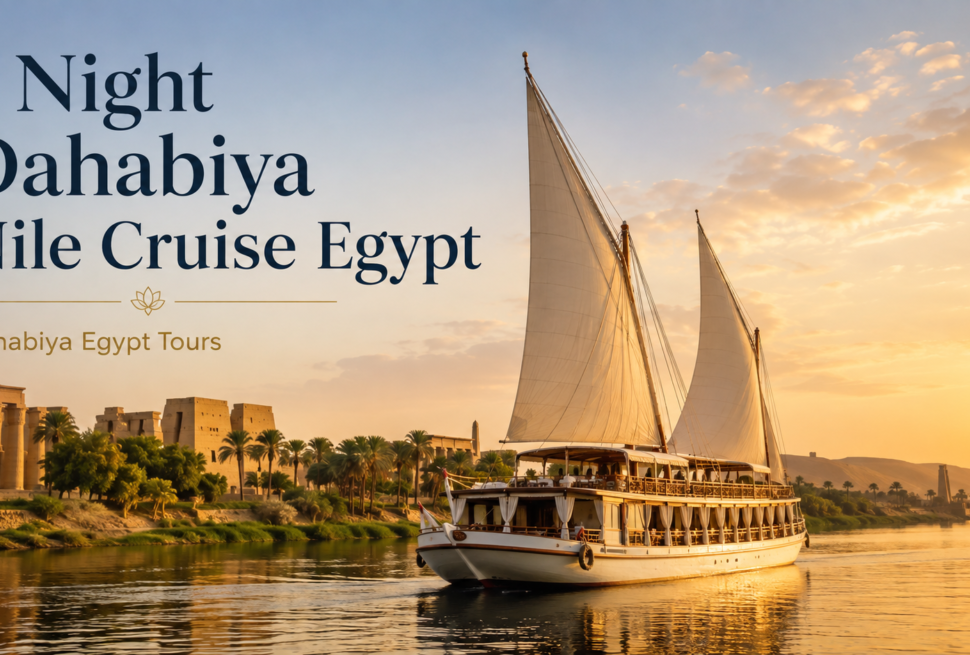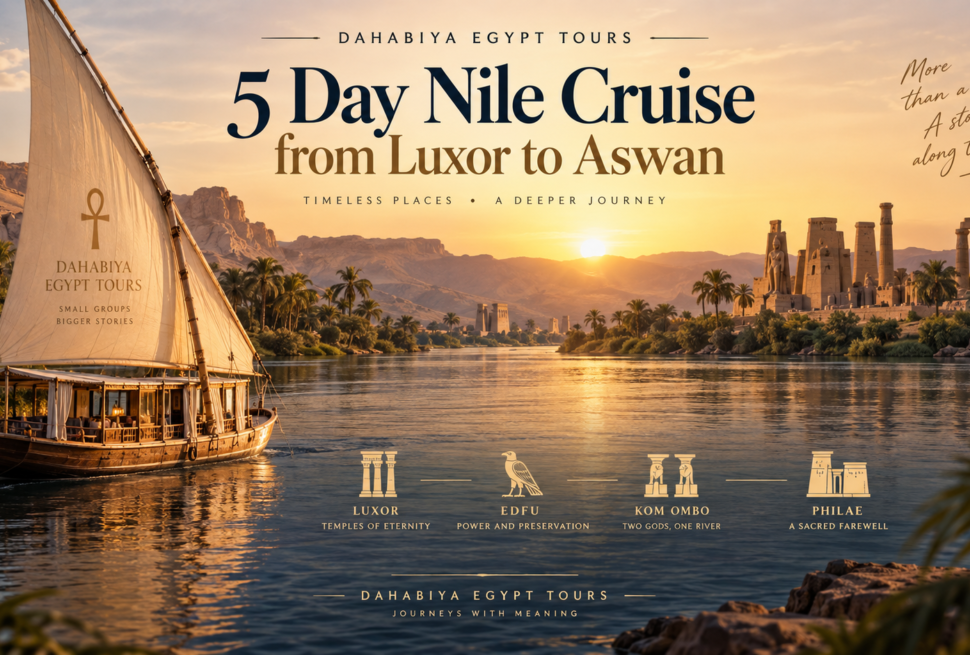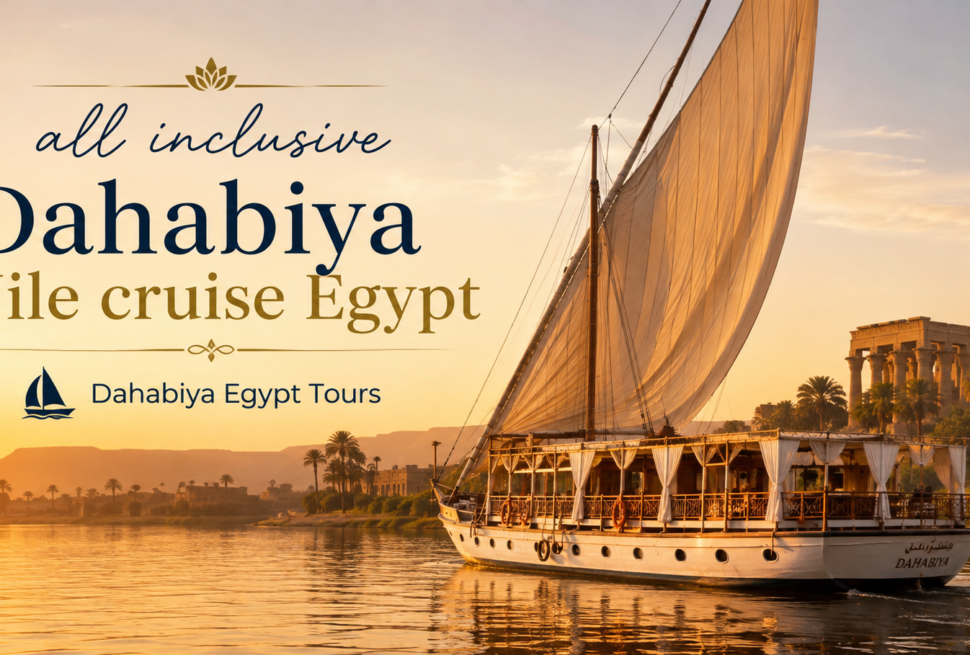
4 Day Dahabiya Nile Cruise from Aswan to Luxor
A 4 day Dahabiya Nile cruise from Aswan to Luxor is a compact way to combine relaxed Nile sailing with some of Upper Egypt’s most important archaeological sites. The current Dahabiya Egypt Tours programme runs for four days and three nights, beginning in Aswan and finishing in Luxor, with sightseeing in Aswan, Kom Ombo, Esna and Luxor along the route. Full-board accommodation and guided sightseeing are included in the published programme, while experiences such as Abu Simbel and a Luxor hot-air balloon ride are optional.
For European travellers who want to include Cairo, Upper Egypt and perhaps the Red Sea within one holiday, the northbound route can be particularly practical. Starting in Aswan and finishing in Luxor avoids returning south after the cruise and places you in one of Egypt’s most important historical destinations for the next stage of your journey.
What Is a 4 Day Dahabiya Nile Cruise from Aswan to Luxor?
A four-day Dahabiya cruise is a three-night Nile journey aboard a smaller traditional-style sailing vessel, travelling north from Aswan toward Luxor while combining onboard relaxation with guided archaeological sightseeing.
Dahabiyas are chosen primarily for atmosphere rather than large-resort facilities. Compared with a conventional Nile cruise ship, the smaller format can provide a quieter setting, fewer passengers and a more intimate relationship with the river landscape. For travellers who prefer peaceful deck time and personalised sightseeing over entertainment programmes and large public areas, this difference can be significant.
The main reason to choose a Dahabiya is not simply luxury. It is the opportunity to experience the Nile at a smaller scale, with more emphasis on scenery, historic sites and time on the river.
4 Day Aswan to Luxor Dahabiya Itinerary at a Glance
The currently published Dahabiya Egypt Tours itinerary follows the route below. Exact sailing conditions and operational details can change, so travellers should always reconfirm the final programme before arrival.
| Day | Main Area | Key Experiences | Overnight |
|---|---|---|---|
| Day 1 | Aswan | Philae Temple, Unfinished Obelisk, High Dam, optional Nubian Village | Aswan |
| Day 2 | Aswan – Kom Ombo – Esna | Optional Abu Simbel, Kom Ombo Temple, Crocodile Museum, Nile sailing | Esna |
| Day 3 | Esna – Luxor | Esna Temple, Esna Lock, Karnak Temple and Luxor Temple | Luxor |
| Day 4 | Luxor | Valley of the Kings, Hatshepsut Temple, Colossi of Memnon, optional balloon | Check-out |
Day 1: Begin Your Dahabiya Journey in Aswan
The journey begins with collection from an Aswan hotel or airport and transfer to the Dahabiya. The published sightseeing programme includes Philae Temple, the Unfinished Obelisk and Aswan High Dam. A Nubian Village visit is listed separately as an optional experience.
Philae Temple
Philae provides an excellent introduction to the religious landscape of ancient southern Egypt. Dedicated principally to Isis, the temple complex also gives first-time visitors an immediate sense of how closely Egyptian history is connected with the Nile and the islands around Aswan.
Why the First Night Matters
After a sightseeing day, returning to a small vessel rather than continuing by road changes the pace of the journey. The evening becomes part of the experience: river views, dinner and a quieter transition into the sailing portion of the itinerary.
Day 2: Kom Ombo and the Journey toward Esna
Day two combines sailing with one of the most distinctive temples on the Upper Egyptian Nile. According to the current itinerary, the Dahabiya reaches Kom Ombo Temple, followed by the Crocodile Museum, before continuing north toward Esna.
What Makes Kom Ombo Different?
Kom Ombo is known for its unusual double-temple arrangement associated with Sobek and Horus. Its position beside the Nile also makes the transition from boat to archaeological site feel particularly natural.
Because the itinerary continues toward Esna after the visit, this is also a day when the landscape becomes important. Agricultural land, palms, settlements and desert edges create a constantly changing view from the deck.
Is Abu Simbel Included?
No. Abu Simbel is listed as an optional excursion on the current four-day programme. Travellers interested in adding it should ask about timing, price and departure arrangements before confirming the cruise.
This detail is particularly important when comparing different Dahabiya packages. Seeing “Aswan” in an itinerary does not automatically mean that Abu Simbel is part of the standard cruise price.
Day 3: Esna Temple, Esna Lock and Arrival in Luxor
The third day starts with a visit to the Temple of Khnum at Esna. The current programme then continues north and passes through Esna Lock before reaching Luxor, where sightseeing includes both Luxor Temple and the Karnak Temple Complex.
Passing through Esna Lock
The lock is more than a transport detail. It is one of the practical elements that shapes navigation on this stretch of the Nile. Watching the vessel move through the lock also creates an interesting contrast between the ancient sites visited during the cruise and the modern infrastructure that keeps river navigation moving.
Karnak and Luxor Temple
Arrival in Luxor dramatically changes the archaeological scale of the journey. Karnak is an extensive temple complex associated with generations of Egyptian rulers, while Luxor Temple occupies a prominent position close to the modern city and riverfront.
Visiting these sites after approaching Luxor by river creates a logical historical progression: the journey moves from southern Egypt toward ancient Thebes rather than treating each temple as an isolated attraction.
Day 4: Explore Luxor’s West Bank
The final day focuses on Luxor’s west bank. The published itinerary includes the Valley of the Kings, the Mortuary Temple of Hatshepsut and the Colossi of Memnon before check-out. A sunrise hot-air balloon experience is optional.
Valley of the Kings
The Valley of the Kings is one of the key reasons many travellers finish their Nile journey in Luxor. Rather than a single monument, visitors enter a landscape containing royal tombs from Egypt’s New Kingdom.
The Dahabiya Egypt Tours programme states that the standard Valley of the Kings ticket covers three tombs in accordance with the applicable tourism arrangements. Special tombs, including Tutankhamun and Seti I, require additional tickets.
Hatshepsut Temple and the Colossi of Memnon
Hatshepsut’s terraced mortuary temple provides one of Luxor’s most recognisable archaeological settings. The nearby Colossi of Memnon add another layer to the west-bank visit before the cruise formally concludes.
What Is Included in the 4 Day Dahabiya Cruise?
The current Dahabiya Egypt Tours programme is relatively clear about its inclusions, which makes it easier to compare the total trip cost rather than focusing only on the advertised cruise fare.
- Four days and three nights of Dahabiya accommodation
- Breakfast, lunch and dinner
- Soft drinks as specified by the operator
- Planned sightseeing listed in the standard itinerary
- Entrance tickets to included sites
- Private air-conditioned transfers
- Private tour guide
- Airport or hotel pick-up and drop-off according to the programme
- Required operating permissions
International and domestic flights, optional tours, Egypt entry visa costs, tipping and personal expenses are listed as exclusions. Optional experiences should therefore be priced separately when you request your quotation.
Why This Route Works Well for European Travellers
For visitors travelling from Europe, a four-day route can fit neatly into a broader Egypt itinerary without consuming an entire week. It is long enough to connect Aswan and Luxor by river while leaving time before or after the cruise for Cairo, Alexandria or the Red Sea. see also.
European demand for Upper Egypt is often stronger during autumn, winter and early spring, when travellers generally find archaeological sightseeing more comfortable than during the hottest summer period. Visitors from the UK, France, Germany, Italy, Spain, the Netherlands and Scandinavia are among the markets commonly planning Nile itineraries during these cooler travel periods.
Northbound Travel Can Reduce Backtracking
If your Egypt itinerary reaches Aswan first, travelling north to Luxor creates a natural progression. You can finish the cruise in Luxor and continue to Cairo, the Red Sea or your departure airport rather than returning to Aswan solely because of the cruise route.
When coordinating flights from Europe, avoid building the cruise around an extremely tight same-day connection. A buffer before embarkation gives you more protection if an international or domestic journey is delayed.
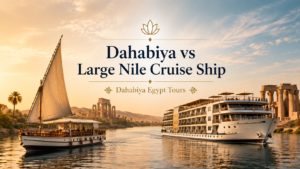
Dahabiya vs Large Nile Cruise Ship
| Factor | Dahabiya | Large Nile Cruise |
|---|---|---|
| Atmosphere | Small-scale and quieter | Busier, hotel-style environment |
| Passenger experience | More intimate | Larger number of guests |
| Facilities | Usually focused on cabins, deck and dining | Often offers more onboard facilities |
| Travel style | River scenery and relaxed sailing | Structured cruise programme |
| Best suited to | Couples, small groups and slow-travel visitors | Travellers prioritising broader ship facilities |
A boutique Dahabiya can cost more per traveller than some conventional Nile cruises because the experience is built around a smaller vessel and fewer passengers. The relevant question is therefore not simply which option is cheaper, but which style better matches your priorities.
Is Four Days Long Enough for a Dahabiya Cruise?
Yes, four days can work well if your priority is combining key Upper Egypt sites with several nights on the Nile. It is particularly useful for travellers working with a compact Egypt itinerary.
However, four days is not the slowest version of the Dahabiya experience. Travellers who primarily want long periods of sailing, additional villages or lesser-visited river stops may prefer a longer four-, five- or seven-night programme. The current four-day Aswan-to-Luxor option is better understood as a concentrated journey rather than an extended slow-travel cruise.
Why Consider Dahabiya Egypt Tours?
Dahabiya Egypt Tours publishes a dedicated four-day, three-night Aswan-to-Luxor programme and identifies both included and optional experiences before booking. The company’s current itinerary covers accommodation, full-board meals, listed entrance fees, private transfers and private guiding while clearly separating optional activities.
That transparency is useful when comparing quotations. Two Nile cruises with similar headline prices may represent very different total costs if one excludes guides, entrance tickets or transfers.
The company also offers other Dahabiya durations and private charter options, which can be useful when travellers want to adapt the Nile portion of a larger tailor-made Egypt itinerary.
What to Check Before Booking
Before paying a deposit, ask for a written quotation covering the complete trip rather than relying on a headline rate.
- Confirm your exact departure date. Dahabiya schedules and availability should match your flights and wider Egypt itinerary.
- Check the cabin category. Ask about bed configuration, bathroom facilities, windows and deck position.
- Review every included entrance ticket. Special-access tombs may require separate tickets.
- Price optional excursions separately. Abu Simbel and the Luxor balloon should not be assumed to be included.
- Confirm transfer points. State your Aswan arrival hotel, airport or railway arrangements clearly.
- Understand payment and cancellation conditions. Request them in writing before confirming.
- Check the final currency. European travellers should compare the actual payable amount rather than relying only on converted headline figures.
Common Mistakes to Avoid
Assuming Every Aswan–Luxor Cruise Has the Same Stops
Itineraries vary. For example, the current four-day Dahabiya Egypt Tours programme lists Kom Ombo and Esna but does not list Edfu as part of this specific published itinerary. Do not assume a famous Nile stop is included simply because another operator visits it.
Comparing Only the Headline Price
A cheaper fare can become more expensive once entrance fees, transfers and guides are added. Compare complete inclusions rather than nightly price alone.
Assuming Abu Simbel Is Automatically Included
Abu Simbel is optional on this itinerary. Confirm both the additional cost and how the early excursion affects the rest of your day.
Booking Tight Connections
A multi-day Nile journey is difficult to rearrange around a missed flight. Build sensible time between your arrival in Egypt and embarkation.
Choosing a Dahabiya for the Wrong Reason
Do not choose a Dahabiya because you expect the facilities of a large cruise liner. Choose it because you value a smaller vessel, peaceful Nile scenery and a more intimate travel format.
Final Thoughts
A 4 day Dahabiya Nile cruise from Aswan to Luxor works particularly well for travellers who want to experience the Nile without committing to a long cruise. In three nights, the route connects Aswan’s monuments with Kom Ombo, Esna and the archaeological landscape of Luxor while still creating time to enjoy the river itself.
Its strongest advantage is balance. You see major sites, travel between two essential Upper Egyptian cities and experience the Nile as part of the journey rather than simply moving between attractions by road.
Before booking, focus on the exact itinerary, inclusions, cabin type and optional excursions. If the published four-day route matches your travel dates and the pace you want, Dahabiya Egypt Tours can help you confirm the available sailing, clarify optional experiences and prepare a quotation around the rest of your Egypt itinerary.
Frequently Asked Questions
1. How long is the Aswan to Luxor Dahabiya cruise?
The published Dahabiya Egypt Tours itinerary lasts four days and three nights, beginning in Aswan and ending in Luxor.
2. What temples are visited during the cruise?
The current programme includes sites in Aswan, Kom Ombo, Esna and Luxor, including Philae, Kom Ombo Temple, Esna Temple, Karnak, Luxor Temple and west-bank attractions.
3. Is Edfu included in this four-day itinerary?
Not in the currently published itinerary. Travellers who specifically want Edfu should confirm whether their programme can include it before booking.
4. Is Abu Simbel included?
No. Abu Simbel is listed as an optional excursion from Aswan on the current itinerary.
5. Are meals included on the Dahabiya?
Yes. The published package includes full-board meals—breakfast, lunch and dinner—plus soft drinks as specified by the operator.
6. Are entrance tickets included?
Entrance fees for the sightseeing listed in the standard itinerary are included. Optional experiences and certain special tomb tickets are separate.
7. Is a private guide included?
Yes. Dahabiya Egypt Tours currently lists a private tour guide among the package inclusions.
8. Is a Dahabiya suitable for couples?
Yes. Its smaller scale and quieter atmosphere can be particularly attractive to couples who prefer relaxed sailing and sightseeing over a large-ship experience.
9. Is four days enough for first-time visitors?
Four days works well for travellers with a compact itinerary. Those wanting substantially more sailing time and additional river stops may prefer a longer programme.
10. How should I book a 4-day Dahabiya cruise?
Contact Dahabiya Egypt Tours with your preferred travel dates, number of travellers, cabin requirements and optional excursions so the itinerary and final quotation can be confirmed before booking.