Dahabiya cruise with private Egyptologist guide
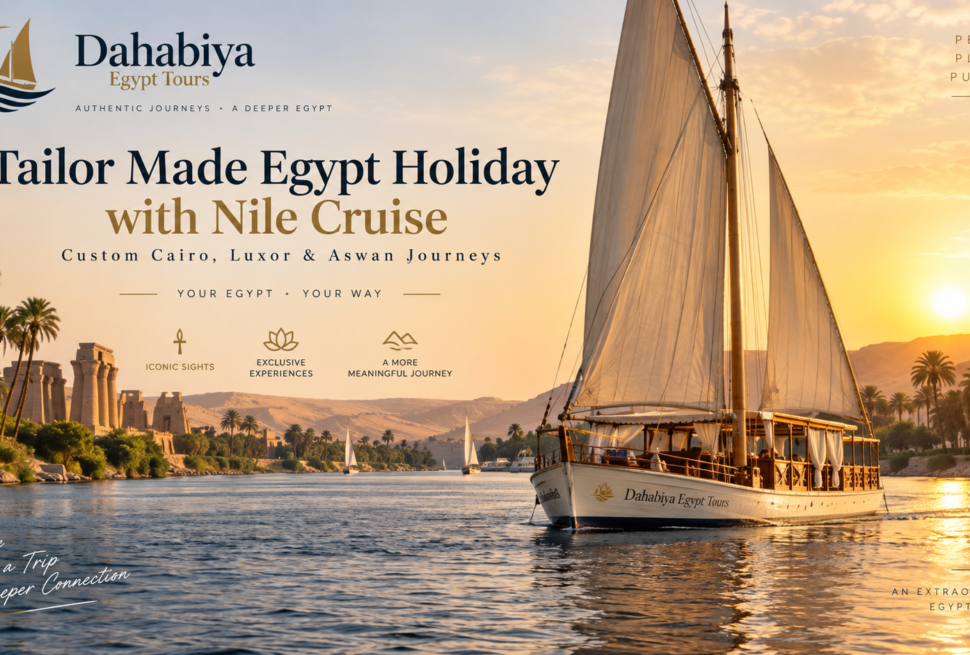
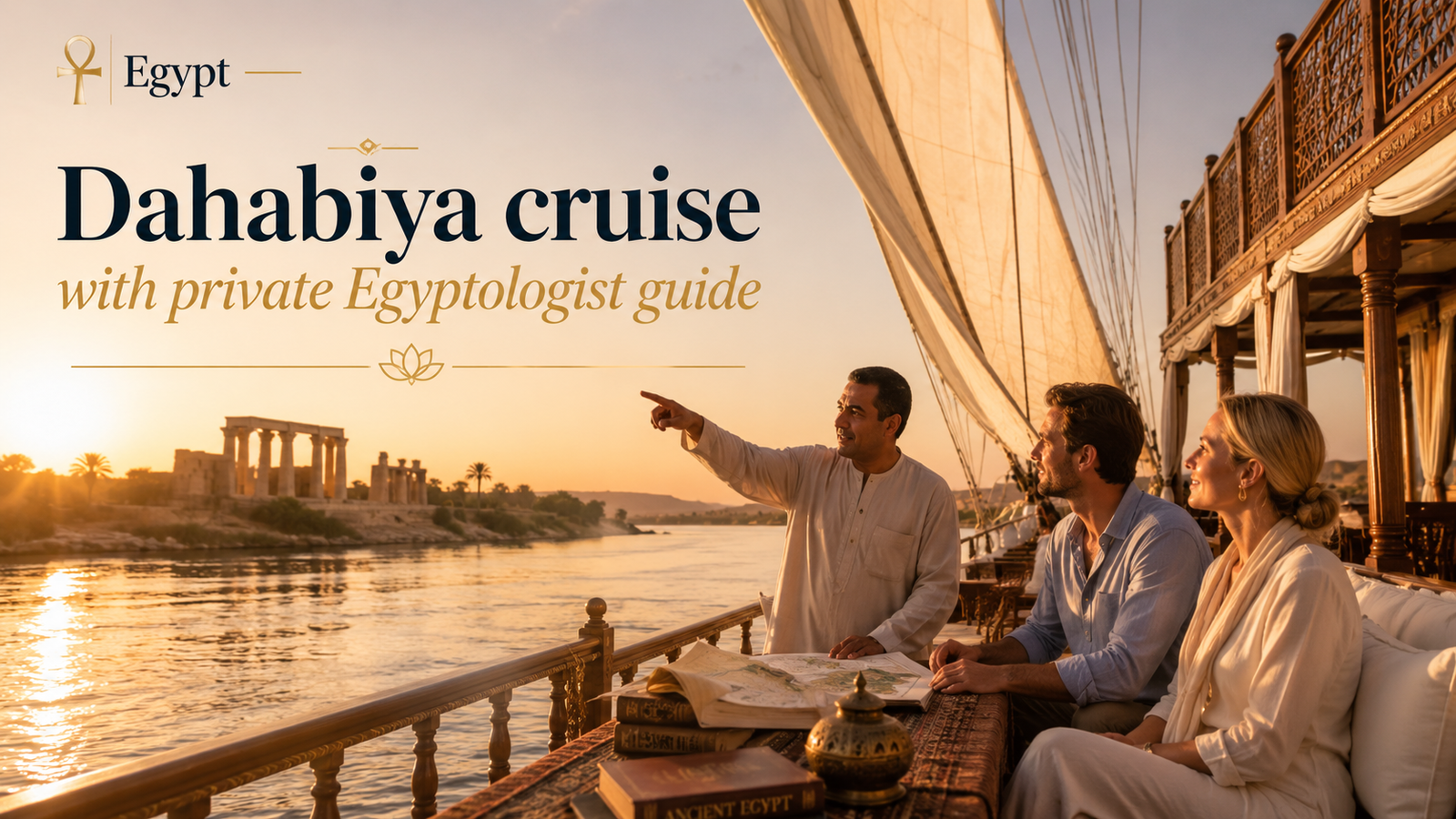
A Dahabiya cruise with a private Egyptologist guide combines slow sailing on the Nile with personalised access to the history of ancient Egypt. Instead of travelling with a large tour group, guests can explore temples, archaeological sites, riverside communities, and the landscapes of Upper Egypt at a more relaxed pace while receiving explanations tailored to their interests.
For European travellers looking for a quieter and more personal alternative to a conventional Nile cruise, Dahabiya Egypt Tours can help create a journey that brings together traditional Nile sailing, private guiding, cultural discovery, and time to appreciate the route between Luxor and Aswan.
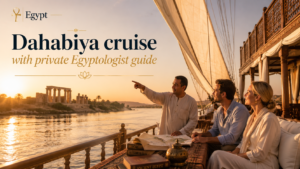
What is a Dahabiya cruise with a private Egyptologist guide?
A Dahabiya cruise is a Nile journey aboard a traditional-style sailing vessel that is considerably smaller and more intimate than the large cruise ships commonly seen between Luxor and Aswan. Adding a private Egyptologist guide means that historical sightseeing is arranged around you or your private party rather than a large group.
The experience is not simply about moving from one archaeological attraction to another. A Dahabiya encourages slower travel. Sailing along the Nile reveals farmland, palm groves, villages, desert landscapes, islands, and historic sites that form the geographical setting in which Egyptian civilisation developed.
A private Egyptologist turns a Nile cruise from a sequence of monument visits into a connected story of ancient Egypt, its rulers, beliefs, architecture, geography, and everyday life.
This combination is particularly attractive to travellers who value cultural depth but do not want their holiday to feel like a classroom. A knowledgeable guide can explain the essential history while adjusting the level of detail to your curiosity and pace.
Why choose a private Egyptologist on a Dahabiya cruise?
The main advantage is personalisation. With a private guide, you can ask questions freely, spend more time on subjects that interest you, and receive context that is difficult to obtain from signs or guidebooks alone.
Understand what you are actually seeing
Egyptian temples contain layers of history. Reliefs, hieroglyphs, architectural changes, religious symbolism, and additions by different rulers can be difficult to interpret without context. An Egyptologist helps connect these details into a coherent narrative.
Instead of simply hearing the name of a pharaoh or deity, you can understand why a particular scene appears on a temple wall, how a sanctuary was used, or why the location mattered politically and religiously.
Explore at your own pace
Large group tours naturally have fixed schedules. Private guiding offers greater flexibility within the practical requirements of the cruise itinerary and site opening arrangements.
If you are fascinated by architecture, mythology, hieroglyphs, archaeology, or photography, your guide can devote more attention to those interests. If you prefer concise explanations followed by independent exploration, the experience can be adapted accordingly.
Ask questions throughout the journey
One of the less obvious benefits of travelling with a private Egyptologist is continuity. Questions often arise after leaving a monument. On a privately guided journey, discussions can continue during transfers or later visits, allowing connections between different periods and sites to become clearer.
Dahabiya vs large Nile cruise: which experience is right for you?
A Dahabiya and a conventional Nile cruise can both provide memorable ways to experience Upper Egypt, but they suit different travel preferences. The key distinction is not simply boat size; it is the rhythm and character of the journey.
| Experience | Dahabiya Cruise | Large Nile Cruise Ship |
|---|---|---|
| Atmosphere | Intimate and relaxed | Busier and more social |
| Passenger numbers | Small-scale | Typically much larger |
| Style of travel | Slow sailing and cultural immersion | Structured cruise programme |
| Guiding | Can be arranged privately | Often organised around groups |
| Shore experience | May include quieter riverside stops depending on the itinerary | Usually focused on established cruise stops |
| Best suited to | Couples, families and travellers seeking privacy and depth | Travellers who enjoy larger facilities and a more conventional cruise format |
Neither option is automatically better for every traveller. A Dahabiya is particularly suitable when privacy, atmosphere, cultural engagement, and a slower pace matter more than the wider facilities associated with a large cruise ship.
Why the Nile between Luxor and Aswan is ideal for slow travel
The Nile corridor through Upper Egypt contains some of the country’s most important archaeological landscapes. Luxor and Aswan are the best-known anchors, while places such as Esna, Edfu, and Kom Ombo add different chapters to the historical journey.
Travelling by Dahabiya makes the landscape itself part of the experience. The river is not merely transportation between attractions. It provides geographical context for understanding why ancient settlements developed where they did and why agriculture, religion, trade, and political power were so closely connected to the Nile.
Edfu and the Temple of Horus
The Temple of Horus at Edfu is one of the major temple complexes of Upper Egypt. A private Egyptologist can help visitors understand its ceremonial spaces, inscriptions, reliefs, and the religious ideas associated with Horus.
Rather than treating the temple as an isolated monument, a good guide can explain how it fits into the broader religious and political history encountered elsewhere along the Nile.
Kom Ombo and its unusual temple
Kom Ombo provides another distinctive archaeological experience. Its temple is unusual because of its dual design and associations with two principal divine cults, including Sobek and Haroeris.
With private interpretation, architectural features that might otherwise appear repetitive begin to reveal differences in ritual function, symbolism, and ancient Egyptian religious practice.
Esna and the riverside landscape
Esna is an important point on the Nile route and is known for its historic temple remains and its connection with river navigation. Depending on the specific Dahabiya itinerary, the journey may also include smaller riverside locations away from the main concentration of large cruise vessels.
Because routes, docking arrangements, river conditions, and operational schedules can vary, travellers should always confirm the exact itinerary before booking rather than assuming every Dahabiya makes identical stops.
Why European travellers choose a Dahabiya cruise in Egypt
For many visitors arriving from Europe, a trip to Egypt combines several priorities: archaeology, warm weather, distinctive landscapes, photography, local culture, and a meaningful break from everyday routines. A Dahabiya fits particularly well with travellers who prefer small-scale experiences over mass tourism.
The slower format also suits couples, mature travellers, families, private groups, and repeat visitors who want to experience the Nile differently. English-language private guiding is especially useful for travellers who want detailed historical explanations without joining a multilingual group excursion.
Travel times from Europe make Egypt accessible for both dedicated cultural holidays and longer itineraries combining Cairo, Luxor, Aswan, and the Nile. The Dahabiya portion can become the quieter centre of a wider Egypt itinerary after busier sightseeing days.
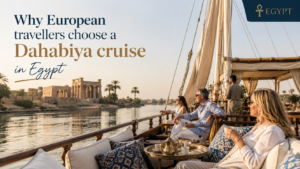
What does a private guided Dahabiya experience feel like?
A typical day balances sightseeing with time on the river. Exact programmes vary by vessel, season, sailing conditions, and itinerary, so the following describes the general rhythm rather than a guaranteed schedule.
- Start the day at a relaxed pace. Depending on the itinerary, sightseeing may begin in the morning when conditions are comfortable.
- Visit a historic site with your Egyptologist. Your guide provides context before and during the visit and answers questions relevant to your interests.
- Return to the Dahabiya. The transition from archaeological sightseeing to the quiet Nile landscape is one of the defining features of this style of travel.
- Spend time sailing or relaxing on board. The riverbanks offer changing views of agricultural land, settlements, palm trees, and desert edges.
- Continue to the next stop. Depending on the route and operational conditions, this could be a major archaeological site or a quieter riverside location.
The absence of constant large-group movement can make the historical visits feel more personal. It also gives travellers time to absorb what they have learned instead of immediately moving to another attraction.
Who should book a private Dahabiya Nile cruise?
A private Dahabiya cruise is best suited to travellers who value privacy, cultural depth, slower travel, and personalised guiding.
- Couples seeking a peaceful cultural journey.
- Families who want explanations adapted to different ages and interests.
- Private groups travelling together in Egypt.
- History and archaeology enthusiasts who want deeper interpretation.
- Photographers who appreciate the landscapes and changing light of the Nile.
- Repeat visitors looking for an alternative to a conventional Nile cruise.
- Travellers who prefer smaller vessels and a quieter atmosphere.
Travellers primarily interested in extensive entertainment facilities, a large choice of onboard venues, or the social atmosphere of a bigger ship may prefer a conventional Nile cruiser.
How to choose the right Dahabiya cruise with a private guide
The quality of a Dahabiya holiday depends on more than attractive boat photographs. Before making a decision, compare the complete travel experience: itinerary, guiding arrangements, accommodation, inclusions, transfers, and the level of personalisation available.
Confirm that the Egyptologist is private
Do not assume that “guided” automatically means privately guided. Ask whether the Egyptologist will accompany only your party during the included sightseeing or whether excursions are shared with other passengers.
Review the itinerary stop by stop
Ask for the planned route and included visits in writing. Pay attention to the starting and finishing points, archaeological sites, smaller stops, transfers, and any experiences described as optional.
Check exactly what the price includes
A useful quotation should make inclusions and exclusions easy to understand. Ask about accommodation, meals, entrance tickets, guiding, transfers, optional excursions, gratuities, beverages, and any additional services relevant to your booking.
Discuss your interests before arrival
A private Egyptologist becomes more valuable when the guiding is genuinely personalised. Tell the operator if you are particularly interested in ancient religion, architecture, archaeology, hieroglyphs, photography, or everyday life in ancient Egypt.
Ask about accessibility and mobility requirements
Historic sites, riverbanks, boarding points, and traditional-style vessels can involve uneven surfaces or steps. Travellers with mobility requirements should discuss them before confirming a booking so that suitability can be assessed accurately.
Why consider Dahabiya Egypt Tours?
Dahabiya Egypt Tours is a relevant option for travellers who want to build their Nile experience around private guiding and the character of Dahabiya travel rather than simply booking a standard cruise package.
The value of working with a specialist is the opportunity to discuss the journey as a complete itinerary. Travellers can ask about the Dahabiya route, private Egyptologist arrangements, sightseeing priorities, transfers, and how the Nile cruise fits with other destinations in Egypt. see also.
This is particularly useful for European visitors planning a multi-stop holiday. A Dahabiya journey may form one part of a wider trip involving Cairo, Luxor, Aswan, or other destinations. Coordinating those elements can reduce unnecessary complexity and help maintain a comfortable travel rhythm.
Before booking with any operator, including Dahabiya Egypt Tours, request the current itinerary, vessel details, inclusions, exclusions, cancellation conditions, and guiding arrangements applicable to your chosen travel dates. Clear information is the foundation of a well-planned private journey.
Practical tips before booking your Nile journey
Choose your trip based on experience rather than price alone. Two Dahabiya packages can look similar at first glance while differing significantly in guiding arrangements, cabin category, included sightseeing, transfers, and itinerary design.
Consider the season as well. Conditions in Upper Egypt vary during the year, and European travellers should think about their personal tolerance for heat when deciding when to travel. Lightweight clothing, sun protection, comfortable walking shoes, and suitable clothing for cultural visits are practical essentials.
It is also sensible to keep some flexibility in your expectations. Dahabiyas are closely connected to the rhythm of the Nile, and operational details can occasionally be influenced by navigation or local conditions. Confirm important arrangements with your operator close to departure.
Common mistakes to avoid when choosing a Dahabiya cruise
The most common mistake is booking from photographs without comparing the actual itinerary and services. A beautiful vessel matters, but the quality of your experience also depends on guiding, route planning, service, and clear communication.
- Assuming every Dahabiya follows exactly the same itinerary.
- Confusing a shared guide with a genuinely private Egyptologist.
- Comparing prices without comparing what is included.
- Trying to fit too many destinations into a short Egypt holiday.
- Failing to communicate dietary, mobility, or other practical requirements before booking.
- Choosing a cruise only by cabin appearance rather than considering the complete experience.
A few detailed questions before payment can prevent misunderstandings and help ensure that the journey matches your expectations.
Is a Dahabiya cruise with a private Egyptologist worth it?
For travellers who want privacy and deeper cultural understanding, it can be one of the most rewarding ways to experience the Nile. The private Egyptologist provides historical context, while the Dahabiya creates the time and atmosphere needed to absorb that history without the pace of a large group itinerary.
The experience is particularly compelling because Egypt’s monuments make more sense when understood in relation to one another. Edfu, Kom Ombo, Luxor, Aswan, and the Nile landscape are not disconnected attractions. Together, they reveal different aspects of religion, politics, architecture, trade, and life along the river.
For visitors who want their trip to Egypt to be more than a checklist of famous places, that continuity can be the strongest reason to choose private guiding.
Frequently Asked Questions
1. What is a Dahabiya cruise in Egypt?
A Dahabiya cruise is a small-scale Nile sailing experience aboard a traditional-style vessel. It offers a quieter, slower alternative to travelling on a large Nile cruise ship.
2. Can I have a private Egyptologist on a Dahabiya cruise?
Yes. Private Egyptologist guiding can be arranged on suitable Dahabiya itineraries. Confirm that the guide is dedicated to your party rather than shared with other passengers.
3. Why hire a private Egyptologist?
A private Egyptologist explains the history, architecture, symbolism, and archaeological context of the sites while adapting the visit to your interests and preferred pace.
4. Where do Dahabiya cruises usually sail?
Dahabiya journeys commonly operate on the Nile in Upper Egypt, with routes associated with the Luxor-Aswan corridor. Exact embarkation points and stops depend on the selected itinerary.
5. Does a Dahabiya visit Edfu and Kom Ombo?
Many itineraries include major sites in this part of the Nile Valley, but routes vary. Check the written itinerary to confirm whether Edfu, Kom Ombo, and other desired stops are included.
6. Is a Dahabiya suitable for couples?
Yes. The smaller scale, relaxed atmosphere, and possibility of private guiding make Dahabiya travel particularly appealing to couples seeking a quieter Nile experience.
7. Is a Dahabiya suitable for families?
It can be. Private guiding allows explanations to be adapted for different ages, but families should confirm cabin arrangements, safety considerations, and the suitability of the specific vessel before booking.
8. What should I ask before booking?
Confirm the vessel, itinerary, private guiding arrangements, accommodation, meals, entrance tickets, transfers, inclusions, exclusions, payment terms, and cancellation conditions.
9. How is a Dahabiya different from a standard Nile cruise?
A Dahabiya is smaller and generally focuses on a slower, more intimate river experience. Large cruise ships typically carry more passengers and offer a more conventional cruise format.
10. How can I plan a private Dahabiya cruise in Egypt?
Start with your travel dates, number of guests, preferred route, and sightseeing interests. Then request a detailed itinerary and current quotation from a specialist such as Dahabiya Egypt Tours.
Experience the Nile with time to understand it
A Dahabiya cruise with a private Egyptologist guide is designed for travellers who want to experience the Nile rather than simply pass through it. Small-scale sailing creates space for the landscape, while private guiding gives meaning to temples, inscriptions, ancient beliefs, and the historical places encountered along the route.
For European travellers planning a cultural journey through Egypt, the combination offers an appealing balance of discovery and relaxation. The most important step is choosing an itinerary that matches your interests and understanding exactly what is included before confirming your trip.
If you are considering a private Nile journey, contact Dahabiya Egypt Tours with your preferred travel dates, number of travellers, and the places or historical themes you would most like to explore. The next logical step is to review a tailored itinerary and decide whether the pace, guiding, and route are right for your Egypt journey.