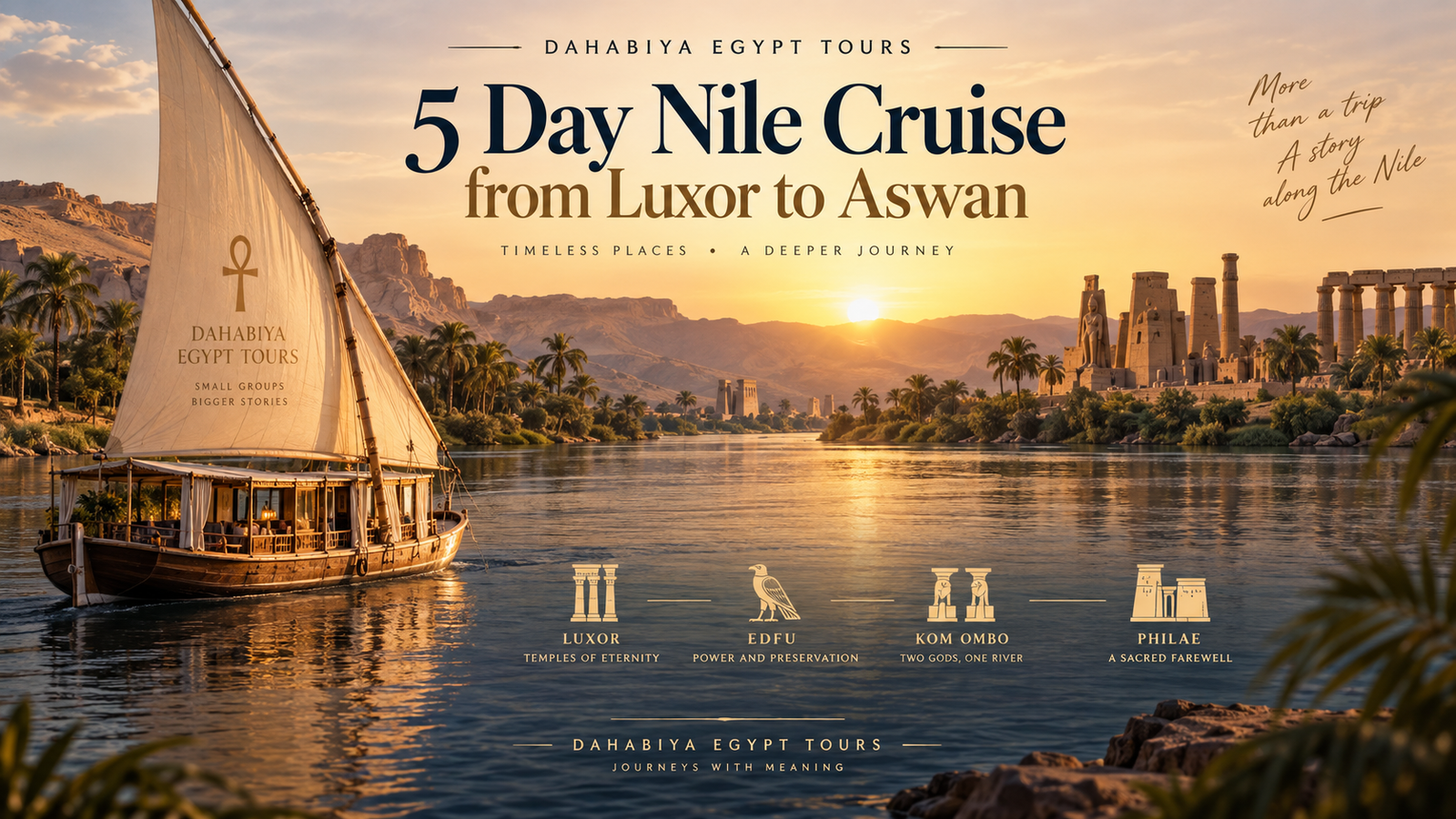
5 Day Nile Cruise from Luxor to Aswan
A 5 day Nile cruise from Luxor to Aswan is usually a four-night journey through Upper Egypt, combining the major archaeological sites of Luxor with Edfu, Kom Ombo and Aswan. It is one of the easiest ways to explore the Nile Valley because your accommodation travels with you, reducing repeated hotel changes and long road journeys. Depending on your preferred travel style, you can choose a classic cruise ship or a smaller Dahabiya. Dahabiya Egypt Tours can help you consider the pace, vessel type, sightseeing programme and practical details before you book.
What Is a 5 Day Nile Cruise from Luxor to Aswan?
A five-day Nile cruise is a southbound journey through one of the most historically important sections of Egypt. It begins around Luxor, follows the Nile through Upper Egypt and finishes in Aswan, allowing travellers to combine ancient temples with several days of river scenery.
The route is especially useful for first-time visitors because Luxor contains major sites on both sides of the Nile. The East Bank is known for Karnak Temple and Luxor Temple, while the West Bank includes the Valley of the Kings, the Temple of Hatshepsut and other important monuments. After Luxor, cruises normally continue towards Edfu and Kom Ombo before reaching Aswan.
The important point is that a five-day cruise is not simply transportation. The sailing time, views of palm-lined riverbanks, agricultural land and small Nile communities are part of the experience. For many travellers, this balance between archaeology and time on the river is what makes the journey different from touring the same region entirely by car.
Why the Luxor to Aswan Route Works Well for European Travellers
The Luxor-to-Aswan route fits naturally into a wider Egypt itinerary. European visitors can spend time in Cairo and Giza first, continue to Luxor, cruise south and then finish in Aswan before extending the journey to Abu Simbel, the Red Sea or another part of Egypt.
It also reduces the need to pack and unpack every day. Instead of changing hotels between archaeological sites, travellers sleep aboard the vessel while moving between destinations. This is particularly useful when the goal is to see several important sites without making the trip feel like a sequence of long transfers.
Seasonality matters as well. Upper Egypt is hot during summer, while winter brings milder conditions that many European visitors find more comfortable for outdoor sightseeing. Whatever the season, sun protection, water and suitable clothing remain important because most archaeological visits involve walking in exposed areas.
5 Day Nile Cruise from Luxor to Aswan Itinerary
A typical 5 day, 4 night Luxor to Aswan cruise follows the itinerary below. The precise order may change according to the boat, docking arrangements, sailing conditions, operating schedules and the programme confirmed for your departure.
| Day | Destination | Main Experiences |
|---|---|---|
| Day 1 | Luxor | Embarkation, Karnak Temple and Luxor Temple |
| Day 2 | Luxor to Esna | Valley of the Kings, Temple of Hatshepsut and sailing south |
| Day 3 | Edfu | Temple of Horus and Nile sailing |
| Day 4 | Kom Ombo to Aswan | Kom Ombo Temple and continuation to Aswan |
| Day 5 | Aswan | Philae Temple and selected Aswan sightseeing before departure |
Day 1: Board in Luxor and Explore the East Bank
Your journey normally begins with embarkation in Luxor. Depending on your arrival time and confirmed programme, sightseeing may include Karnak Temple and Luxor Temple. Karnak is an enormous religious complex developed across different periods of ancient Egyptian history, while Luxor Temple stands closer to the modern city and the Nile.
After sightseeing, return to the vessel for dinner and your first night aboard. Confirm your boarding time before travelling to the dock, especially if you are arriving in Luxor by domestic flight or train on the same day.
Day 2: Discover Luxor West Bank and Sail Towards Esna
The second day commonly focuses on Luxor’s West Bank. The Valley of the Kings is the central stop, followed by sites such as the Temple of Hatshepsut and the Colossi of Memnon, depending on the programme.
A qualified Egyptologist can make a considerable difference here. Tomb decoration, royal symbolism and changes between dynasties are easier to understand when the visit has historical context rather than simply moving between monuments.
Later, the cruise begins its journey south. Classic Nile ships generally continue through the Esna area, while some Dahabiya programmes use different embarkation or sailing arrangements. If you specifically want to experience Esna or the lock, confirm this before booking rather than assuming every vessel follows the same procedure.
Day 3: Visit Edfu and Enjoy the Nile Valley
Edfu is one of the principal archaeological stops between Luxor and Aswan. Its Temple of Horus is particularly valuable for travellers who want to understand the religious architecture of the later periods of ancient Egypt.
Once sightseeing is complete, the journey continues along the Nile. This is a good day to spend more time on deck. The contrast between fertile riverbanks and the surrounding desert is one of the defining landscapes of Upper Egypt.
Smaller Dahabiya vessels may place greater emphasis on slow sailing and quieter river stops, while larger cruise ships usually operate according to a more structured timetable.
Day 4: Explore Kom Ombo and Continue to Aswan
Kom Ombo Temple stands directly beside the Nile and is unusual because its layout is associated with two principal deities: Sobek and Horus in the form commonly called Haroeris or Harwer. This makes the temple architecturally and religiously different from many other stops on the route.
After the visit, the cruise continues towards Aswan. The landscape gradually changes as granite formations and islands become more prominent. Your final evening aboard may be spent in Aswan or approaching the city, depending on the vessel’s schedule.
Day 5: See Aswan and Disembark
The final day commonly includes Philae Temple, one of Aswan’s most recognisable ancient sites. Some programmes also include the Unfinished Obelisk, the High Dam or other local attractions. These inclusions should always be checked against the itinerary you are actually purchasing.
If your Egypt itinerary allows it, consider spending an additional night in Aswan rather than leaving immediately. It gives you more flexibility for a trip to Abu Simbel, a Nubian cultural experience or simply more time to enjoy the quieter character of the city.
Classic Nile Cruise or Dahabiya: Which Should You Choose?
Both options travel through the same broad region, but the atmosphere can be very different. A classic Nile cruise is closer to a floating hotel, while a Dahabiya offers a smaller-scale sailing experience.
| Feature | Classic Nile Cruise | Dahabiya |
|---|---|---|
| Atmosphere | Larger and more structured | Smaller and more intimate |
| Schedule | Usually fixed | Often slower and potentially more flexible |
| Facilities | Typically more onboard facilities | Focus on space, sailing and personal atmosphere |
| Best for | Travellers wanting hotel-style cruise facilities | Couples, families and travellers seeking a quieter Nile experience |
Neither style is automatically better. Choose according to the experience you want. Travellers who value pools, larger lounges and a conventional cruise structure may prefer a classic vessel. Those who care more about a quiet deck, smaller guest numbers and the rhythm of sailing may prefer a Dahabiya cruise from Luxor to Aswan.
What Is Usually Included in a 5 Day Nile Cruise?
Most Nile cruise packages combine accommodation and meals with at least part of the sightseeing programme, but inclusions are not identical across operators. Never compare two prices until you understand exactly what each package contains.
- Four nights of accommodation aboard the confirmed vessel.
- Meals according to the selected board basis, often full board.
- Scheduled sightseeing listed in the itinerary.
- Guide services where specified.
- Local transportation required for included shore excursions.
- Entrance tickets only when explicitly stated.
- Pickup and drop-off transfers when included in the quotation.
International flights, Egypt visas, personal expenses, drinks, gratuities and optional trips such as Abu Simbel may be separate. Request a written list of inclusions and exclusions before paying a deposit.
How to Choose the Right Luxor to Aswan Nile Cruise
The right cruise is the one that matches your expectations, not simply the one with the most impressive description. Use the following process before booking:
- Choose between a classic cruise ship and a smaller Dahabiya.
- Confirm that the trip is five days and four nights, not another duration described differently.
- Request the exact sightseeing itinerary and included entrance tickets.
- Check the vessel name, cabin category, deck position and bedding configuration.
- Confirm embarkation and disembarkation locations, transfer arrangements and optional excursions in writing.
It is also worth asking about dietary requirements, guide language, Wi-Fi expectations and luggage arrangements. These questions may seem minor before departure but can have a noticeable effect on a multi-day journey.
Best Time for a Nile Cruise from Luxor to Aswan
For many European travellers, the cooler part of the year is the most comfortable time for a Nile cruise because archaeological sightseeing involves significant time outdoors. October through April is often favoured for milder conditions, although the route operates at other times of year as well.
Winter mornings and evenings can feel cooler on deck than expected, so a light layer is useful. During warmer months, plan for stronger heat and sun exposure. A hat, sunglasses, breathable clothing, sunscreen and water are useful throughout much of the year.
High-demand periods can also affect cabin availability, so travellers with fixed European school holidays, Christmas travel dates or Easter schedules should consider planning earlier rather than relying on last-minute availability.
Why Consider Dahabiya Egypt Tours?
Planning a Nile cruise involves more than choosing a boat. The cruise must connect correctly with your arrival in Luxor, your departure from Aswan and the rest of your Egypt itinerary. A local specialist such as Dahabiya Egypt Tours can be particularly useful when you want to compare a classic Nile cruise with a Dahabiya or combine the sailing with private sightseeing elsewhere in Egypt.
The most useful booking conversation should focus on your actual travel style. Tell the team whether you prioritise privacy, archaeological depth, cabin comfort, slower sailing, family-friendly arrangements or a particular budget. This creates a more useful recommendation than selecting a package only because it is labelled “luxury”.
Before confirming with Dahabiya Egypt Tours, ask for the vessel, itinerary, cabin category, meals, sightseeing, entrance fees, transfers and exclusions in one clear written quotation. Good trip planning begins with clear expectations on both sides.
Practical Tips Before You Book
Arrive in Luxor with enough time before embarkation. Booking a flight that lands immediately before the boat is scheduled to depart creates unnecessary risk if your inbound journey is delayed.
Ask where the vessel actually boards. Some programmes marketed as Luxor-to-Aswan journeys may involve a land transfer to another embarkation point, particularly with certain Dahabiya itineraries.
Check the cabin position rather than focusing only on the category name. Proximity to engines, public areas or stairs can matter to light sleepers. If quiet accommodation is important, mention it before the cabin is assigned.
Finally, keep one flexible night after the cruise if Abu Simbel is important to you. Trying to combine disembarkation, a long excursion and onward travel on the same day can make an otherwise relaxed Nile journey unnecessarily rushed. see also.
Common Mistakes to Avoid When Booking a Nile Cruise
One common mistake is assuming that “five days” means five nights. On this route, five days normally means four nights, so compare packages by both days and nights.
Another mistake is comparing prices without checking inclusions. One quotation may contain guided sightseeing, entrance tickets and transfers, while another may cover mainly accommodation and meals.
Travellers also sometimes assume every Nile cruise follows an identical schedule. Sailing times, docking locations and sightseeing sequences can vary. Treat an online itinerary as a planning guide until your operator confirms the programme for your departure.
Finally, avoid choosing solely by star rating or the word “luxury”. Look at recent cabin photographs, vessel size, service style, sightseeing arrangements and the elements that matter to your own trip.
Is a 5 Day Nile Cruise from Luxor to Aswan Worth It?
Yes, five days is a well-balanced amount of time for travellers who want to see the principal archaeological stops between Luxor and Aswan while still experiencing the Nile itself. The four-night format gives you more breathing room than trying to visit the same destinations through a sequence of independent road trips.
The route is particularly suitable for a first visit to Upper Egypt because it connects several major sites in a logical geographical order. If you have more time, additional nights in Luxor or Aswan can add depth without changing the core cruise experience.
Plan Your Luxor to Aswan Cruise with Confidence
A 5 day Nile cruise from Luxor to Aswan brings together several of Egypt’s defining experiences: the temples of Luxor, royal tombs on the West Bank, Edfu, Kom Ombo, the scenery of the Nile Valley and the distinctive atmosphere of Aswan.
The key is choosing the right style of vessel and knowing exactly what your itinerary includes. Compare the pace, cabin, guide arrangements, sightseeing programme and transfers rather than making a decision on price alone.
If you are ready to build the cruise into a wider Egypt holiday, contact Dahabiya Egypt Tours with your travel dates, number of guests and preferred travel style. The next logical step is to request a clear itinerary and cruise option that fits the way you want to experience the Nile.
Frequently Asked Questions About a 5 Day Nile Cruise from Luxor to Aswan
1. How many nights is a 5 day Nile cruise from Luxor to Aswan?
A five-day Nile cruise is normally four nights, although you should confirm the exact duration on your booking documents.
2. What places are normally visited on the cruise?
Typical stops include Luxor, Edfu, Kom Ombo and Aswan, with sightseeing at major temples and archaeological sites along the route.
3. Is five days enough for Luxor and Aswan?
Five days is enough for the main cruise highlights, but extra nights in Luxor or Aswan are useful if you want deeper sightseeing.
4. Is a Dahabiya better than a large Nile cruise ship?
A Dahabiya suits travellers who prefer a smaller and quieter experience. A larger cruise ship may offer more hotel-style facilities.
5. Are meals included on a Nile cruise?
Many cruises operate on a full-board basis, but meal and beverage inclusions vary. Check the confirmed package before booking.
6. Are temple entrance fees included?
Sometimes. Entrance fees may be included in a sightseeing package or charged separately, so request a written list of inclusions.
7. Is Abu Simbel included in a 5 day Nile cruise?
Abu Simbel is often treated as a separate or optional excursion from Aswan rather than a standard cruise stop.
8. What is the best season for a Luxor to Aswan cruise?
Many travellers prefer the milder months from autumn through spring, while summer travel requires greater preparation for daytime heat.
9. Do I need an Egyptologist guide?
A knowledgeable Egyptologist is highly valuable because the temples and tombs contain historical and religious details that are easy to miss without interpretation.
10. What should I pack for a Nile cruise?
Pack comfortable walking shoes, breathable clothing, sun protection, a hat and a light layer for cooler evenings or air-conditioned interiors.