
Dahabiya Nile Cruise with Abu Simbel
A Dahabiya Nile cruise with Abu Simbel combines two of southern Egypt’s most memorable travel experiences: slow, intimate sailing along the Nile between Luxor and Aswan and a visit to the monumental rock-cut temples of Abu Simbel. The important detail is that a traditional Dahabiya does not normally sail directly to Abu Simbel. Instead, the cruise reaches or departs from Aswan, where Abu Simbel can be added as a private road excursion or, when suitable flights are available, an air excursion.
This combination is ideal for travelers who want the atmosphere of a small Nile sailing vessel without missing one of Egypt’s most significant archaeological sites. Dahabiya Egypt Tours can integrate the cruise, Aswan sightseeing and Abu Simbel into a coordinated Egypt itinerary rather than treating each experience as an unrelated booking.

Can You Combine a Dahabiya Nile Cruise with Abu Simbel?
Yes. A Dahabiya Nile cruise can easily be combined with Abu Simbel by adding the temple visit before or after the cruise reaches Aswan. The classic Dahabiya sailing corridor is between Luxor and Aswan, while Abu Simbel lies farther south in Nubia, close to Egypt’s southern border.
Current Dahabiya itineraries commonly treat Abu Simbel as an extension from Aswan rather than a direct sailing stop. Dahabiya Egypt Tours also includes Abu Simbel as an optional extension within Egypt itineraries that travel through Luxor and Aswan.
The practical route is usually: sail the Nile to Aswan, stay overnight or allow sufficient time in Aswan, visit Abu Simbel, and then continue with the rest of your Egypt journey.
This distinction matters when comparing packages. A tour advertised as a “Dahabiya cruise with Abu Simbel” should explain clearly whether transfers, entrance arrangements, guiding and an Aswan overnight stay are included.
Why Abu Simbel Is Worth Adding to a Dahabiya Cruise
Abu Simbel adds a different dimension to a Nile journey. Luxor, Edfu, Kom Ombo and Aswan reveal successive layers of ancient Egyptian history along the river. Abu Simbel then takes travelers deeper into ancient Nubia and the southern frontier of pharaonic Egypt.
The archaeological complex contains two rock-cut temples commissioned by Ramesses II. The Great Temple is dominated by four colossal seated statues of the king, while the smaller temple honors the goddess Hathor and Queen Nefertari. Egypt’s Ministry of Tourism and Antiquities identifies the temples as among the most remarkable monuments in the country.
Abu Simbel also belongs to the UNESCO World Heritage property known as the Nubian Monuments from Abu Simbel to Philae. The temples were relocated through an international rescue campaign when construction of the Aswan High Dam threatened ancient Nubian monuments with flooding.
For travelers already reaching Aswan, adding Abu Simbel creates a logical historical progression rather than requiring a completely separate journey to southern Egypt.
How a Dahabiya Nile Cruise with Abu Simbel Usually Works
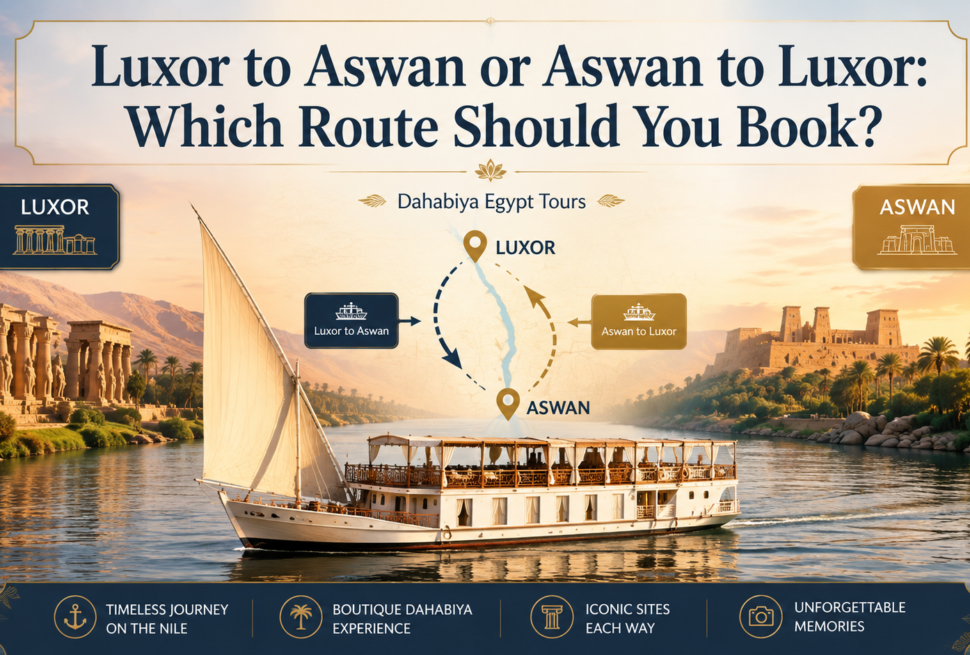
The most comfortable itinerary depends on whether your Dahabiya travels south from Luxor to Aswan or north from Aswan toward Luxor.
Option 1: Luxor to Aswan Dahabiya with Abu Simbel After the Cruise
This is one of the easiest arrangements for first-time visitors. Begin with the monumental sites of Luxor, sail south through Upper Egypt, finish in Aswan, and then travel to Abu Simbel.
- Explore Luxor and embark on the Dahabiya.
- Sail south through the Nile Valley.
- Visit archaeological sites around Edfu and Kom Ombo according to the selected itinerary.
- Arrive in Aswan and explore its principal attractions.
- Stay in Aswan if necessary.
- Take a private excursion from Aswan to Abu Simbel.
- Return to Aswan before continuing to Cairo, the Red Sea or another Egyptian destination.
This structure is particularly convenient because it places Abu Simbel at the natural southern end of the journey.
Option 2: Abu Simbel Before an Aswan to Luxor Dahabiya
Travelers starting their cruise in Aswan can visit Abu Simbel first and then begin their Dahabiya journey north toward Luxor. This can work well when arriving in Aswan by air from Cairo or when spending several days exploring southern Egypt.
The main advantage is that the long excursion is completed before boarding, leaving the remainder of the trip focused on relaxed Nile sailing.
Sample Dahabiya and Abu Simbel Itinerary
| Stage | Destination | Experience |
|---|---|---|
| Day 1 | Luxor | Ancient Thebes, East or West Bank sightseeing and Dahabiya embarkation |
| Day 2 | Upper Egypt | Relaxed Nile sailing and riverside scenery |
| Day 3 | Edfu Area | Temple visits and sailing through rural Upper Egypt |
| Day 4 | Kom Ombo | Visit the riverside temple and continue toward Aswan |
| Day 5 | Aswan | Disembarkation or Aswan sightseeing, depending on the cruise schedule |
| Day 6 | Abu Simbel | Private excursion to the temples and return to Aswan |
This is an illustrative structure rather than a fixed schedule. Sailing conditions, the chosen Dahabiya, embarkation points and excursion arrangements can affect the exact program. A personalized itinerary should therefore be confirmed before booking.

What You Can See Between Luxor and Aswan
A Dahabiya journey is valuable because the river experience becomes part of the trip rather than simply transportation between archaeological sites.
Luxor
Luxor provides access to some of Egypt’s most important ancient monuments. Depending on your wider itinerary, visits can include Karnak Temple, Luxor Temple, the Valley of the Kings, Hatshepsut’s mortuary temple and the Colossi of Memnon.
Edfu
Edfu is known for the Temple of Horus. The stop adds an important Greco-Roman period monument to an itinerary that may already include New Kingdom sites in Luxor.
Kom Ombo
Kom Ombo offers one of the Nile Valley’s most distinctive temple settings. Its riverside location makes the transition between sailing and archaeological sightseeing particularly natural.
Aswan
Aswan is much more than the transfer point for Abu Simbel. Visitors can explore Philae, the granite landscape, Nile islands and aspects of Nubian culture before continuing farther south.
Philae and Abu Simbel are both part of the UNESCO-listed group of Nubian monuments stretching through the Aswan region, strengthening the historical connection between the two destinations.
Dahabiya Cruise vs Conventional Nile Cruise with Abu Simbel
| Feature | Dahabiya Cruise | Conventional Nile Cruise |
|---|---|---|
| Atmosphere | Small-scale and intimate | Larger and more structured |
| Pace | Slower, experience-focused sailing | Usually follows a fixed cruise program |
| Outdoor experience | Strong emphasis on open-deck Nile views | Depends on vessel size and facilities |
| Privacy | Generally greater due to fewer guests | Usually shared with larger groups |
| Abu Simbel | Added separately from Aswan | Usually also added as an Aswan excursion |
| Best for | Slow travel, couples and personalized journeys | Travelers wanting larger onboard facilities |
A Dahabiya is especially attractive when the journey itself matters as much as the famous monuments. Rather than rushing between major sightseeing stops, travelers have more opportunities to appreciate the landscape, villages, farmland and changing light along the Nile.
How Do You Travel from Aswan to Abu Simbel?
Abu Simbel is generally visited from Aswan by road or by air, depending on the itinerary, budget and available transport schedules.
Private Road Transfer
A private air-conditioned vehicle is a practical option because departure and return arrangements can be coordinated with your cruise and hotel schedule. The journey crosses the desert south of Aswan, so it is important to plan adequate time and avoid creating a tight onward connection on the same day.
Flight from Aswan
Domestic flights may provide an alternative when schedules align with the travel date. Flight availability and timings can change, so travelers should confirm the actual operating schedule rather than building an itinerary around assumed departure times.
For many travelers, the better choice is not simply the fastest option. It is the option that fits comfortably between the cruise, accommodation and onward travel.
How Much Time Should You Allow for Abu Simbel?
Abu Simbel should be treated as a major excursion rather than squeezed into a crowded Aswan sightseeing day. Road transportation requires substantial travel time in addition to the temple visit itself.
A sensible itinerary therefore leaves enough flexibility around the excursion. If your international or domestic flight departs immediately after the planned return from Abu Simbel, even a small delay can create unnecessary pressure.
Adding an overnight stay in Aswan can make the overall journey considerably more comfortable, particularly for couples, families, senior travelers and anyone seeking a relaxed luxury Egypt itinerary.
Best Time for a Dahabiya Nile Cruise and Abu Simbel
Season and temperature should influence how you plan Upper Egypt. Luxor, Aswan and Abu Simbel have a hot desert climate, and daytime conditions can become demanding during the warmest part of the year.
The cooler months are generally more comfortable for extensive archaeological sightseeing. Travelers visiting during warmer periods should prioritize hydration, sun protection, lightweight clothing and well-planned excursion times.
Regardless of season, check current operating hours, transportation arrangements and site conditions shortly before travel because these practical details may change.
Who Should Choose This Egypt Itinerary?
A private Dahabiya cruise with Abu Simbel is especially well suited to travelers who value culture, privacy and a measured pace.
- Couples planning a romantic or honeymoon journey in Egypt
- History enthusiasts who want more than the main Luxor attractions
- Travelers seeking a boutique alternative to large cruise vessels
- Families wanting a more personalized sightseeing schedule
- Photographers interested in Nile landscapes and ancient architecture
- Visitors combining Cairo, Luxor, Aswan and southern Nubia
- Travelers who prefer private guiding and coordinated transfers
It is less suitable for visitors attempting to see all of Upper Egypt in only a few days. The Dahabiya experience works best when enough time is allowed to enjoy the river rather than turning every day into a race between monuments.
What Should Be Included Before You Book?
Two packages with similar titles may include very different services. Before confirming your Dahabiya and Abu Simbel itinerary, request the exact inclusions in writing.
- Name and category of the Dahabiya
- Cabin type and sleeping arrangement
- Embarkation and disembarkation locations
- Meals included on board
- Private or shared sightseeing arrangements
- Egyptologist guide services
- Entrance fees and optional tickets
- Transfers between hotels, cruise and archaeological sites
- Abu Simbel transportation method
- Aswan accommodation, if required
- Cancellation and payment conditions
Do not assume that the phrase “with Abu Simbel” automatically means entrance fees, transportation and guiding are included. Confirm each element individually.
Common Mistakes When Planning a Dahabiya Cruise with Abu Simbel
Assuming the Dahabiya Sails to Abu Simbel
The traditional Luxor–Aswan Dahabiya route and the Abu Simbel excursion are separate parts of the journey. Abu Simbel is normally accessed from Aswan rather than by continuing aboard the same Dahabiya.
Planning an Extremely Tight Day in Aswan
Trying to combine Abu Simbel, several Aswan monuments and onward transport in one compressed schedule can reduce the enjoyment of every experience.
Choosing a Cruise Only by Price
Cabin standards, guiding, included excursions, meals, transfers and the number of guests can be just as important as the headline fare.
Not Checking What “Luxury” Means
Luxury on a Dahabiya is often about privacy, service, comfort, space and personalized travel rather than large-ship entertainment facilities. Review the actual vessel and inclusions instead of relying only on marketing terminology.
Leaving Abu Simbel Until the Last Minute
Transport availability and your wider Egypt schedule should be considered when the itinerary is first designed. Abu Simbel works best when incorporated into the trip rather than added after every other connection has already been booked.
Why Plan the Journey with Dahabiya Egypt Tours?
Dahabiya Egypt Tours specializes in private Egypt journeys, Dahabiya cruises, guided tours and tailor-made itineraries. Its current tour portfolio covers Luxor, Aswan and Abu Simbel, making it possible to coordinate the river journey and southern Egypt extension within the same travel plan.
The practical advantage of working with one travel planner is coordination. Your Dahabiya dates influence your Aswan accommodation, Abu Simbel departure and onward transportation. Managing these elements together can prevent unnecessary gaps or unrealistic connections. see also.
A personalized itinerary can also be adjusted according to whether you are traveling as a couple, family, private group or solo visitor and whether your wider journey includes Cairo, Giza, the Red Sea or additional destinations in Upper Egypt.
Tips Before Booking Your Dahabiya Nile Cruise with Abu Simbel
- Decide your cruise direction first. Luxor to Aswan often makes Abu Simbel a natural final extension.
- Leave sufficient time in Aswan. Avoid scheduling critical connections immediately after the excursion.
- Ask how Abu Simbel transportation is arranged. Confirm whether it is by private vehicle or flight.
- Review the exact Dahabiya. Check cabin photos, deck areas and vessel specifications before paying.
- Confirm archaeological visits. Dahabiya itineraries differ, so do not assume every temple is included.
- Clarify entrance fees. Determine which tickets are included and which are paid separately.
- Consider your travel pace. One extra night can sometimes improve the experience more than adding another rushed attraction.
Is a Dahabiya Nile Cruise with Abu Simbel Worth It?
For travelers who want both slow Nile travel and a deeper exploration of southern Egypt, the combination is highly worthwhile. A Dahabiya offers the atmosphere of the river between Luxor and Aswan, while Abu Simbel adds one of the most extraordinary monumental sites of ancient Nubia.
The key is thoughtful planning. Abu Simbel should complement the Dahabiya rather than interrupt it. Allow enough time in Aswan, confirm transportation in advance and choose a cruise program that leaves space to experience the Nile rather than simply collecting sightseeing stops.
When those elements are coordinated correctly, the journey creates a natural route through Upper Egypt—from the temples and royal tombs of Luxor, through the landscapes and archaeological sites of the Nile Valley, to Aswan and finally the monumental temples of Ramesses II at Abu Simbel.
Frequently Asked Questions
Can a Dahabiya cruise take you directly to Abu Simbel?
No. Traditional Dahabiya cruises normally operate between Luxor and Aswan. Abu Simbel is generally added as a separate excursion from Aswan.
Can Abu Simbel be included in a Dahabiya package?
Yes. Abu Simbel can be incorporated before or after the Dahabiya cruise, with transportation arranged from Aswan.
Is Abu Simbel near Aswan?
Abu Simbel is in southern Egypt beyond Aswan, close to Egypt’s southern border. Visitors normally use Aswan as the main gateway for the excursion.
What is the best direction for a Dahabiya cruise with Abu Simbel?
Luxor to Aswan is particularly convenient because Abu Simbel can be added after completing the southbound cruise.
Can I visit Abu Simbel before an Aswan to Luxor cruise?
Yes. Travelers can visit Abu Simbel first, return to Aswan and then begin a northbound Dahabiya journey toward Luxor.
Is Abu Simbel a UNESCO World Heritage Site?
Yes. Abu Simbel forms part of the UNESCO World Heritage property called the Nubian Monuments from Abu Simbel to Philae.
Who built the Abu Simbel temples?
The temples were commissioned by Pharaoh Ramesses II. The smaller temple is associated with Hathor and Queen Nefertari.
Should I stay overnight in Aswan before visiting Abu Simbel?
An Aswan overnight stay is often useful because it creates more flexibility around the excursion and onward travel.
Is a Dahabiya suitable for couples?
Yes. The smaller vessel, relaxed pace and open-deck Nile experience make Dahabiya cruises particularly attractive to couples and honeymoon travelers.
How do I book a Dahabiya Nile cruise with Abu Simbel?
Choose your travel dates, preferred cruise direction and number of nights, then request an itinerary that specifically includes the Abu Simbel extension and all required transfers.
Plan Your Dahabiya and Abu Simbel Journey
A Dahabiya Nile cruise with Abu Simbel is more rewarding when every stage connects naturally—from Luxor and the Nile Valley to Aswan and the temples of southern Nubia.
Contact Dahabiya Egypt Tours with your travel dates, number of guests and preferred journey length to build a personalized itinerary combining Dahabiya sailing, private sightseeing and an Abu Simbel excursion with practical transfers and enough time to enjoy each destination.